

Imagine this: you’re at a café, sipping your favorite brew, and you spot a sleek wireless charger on the table. Your heart races, but then a thought strikes—“Is my iPhone even compatible?” Fear not! This article dives into the world of wireless charging compatibility, making sure you won’t be left in the dark (or with a dead battery) while your friends enjoy their untangled charging bliss.
Understanding Wireless Charging Technology
Wireless charging represents a modern convenience for smartphone users. This technology allows devices to charge without the need for physical connectors.
What Is Wireless Charging?
Wireless charging refers to the method of transferring power using electromagnetic fields. This technology primarily utilizes inductive charging, which focuses on generating energy through magnetic fields between a charging pad and a compatible device. The convenience of wireless charging has gained popularity, especially among smartphone users. Many new smartphones support this feature, offering an alternative to traditional wired charging.
How Does Wireless Charging Work?
Wireless charging operates through two essential components: a transmitter and a receiver. The transmitter resides in the charging pad while the receiver is built into the device. When a device is placed on the charging pad, the transmitter generates an electromagnetic field. This field transfers energy to the receiver, converting it back into electrical energy to charge the device’s battery. Compatibility between the charger and device is crucial for efficient charging, aligning with various wireless charging standards, such as Qi.
iPhone Models and Wireless Charging Compatibility
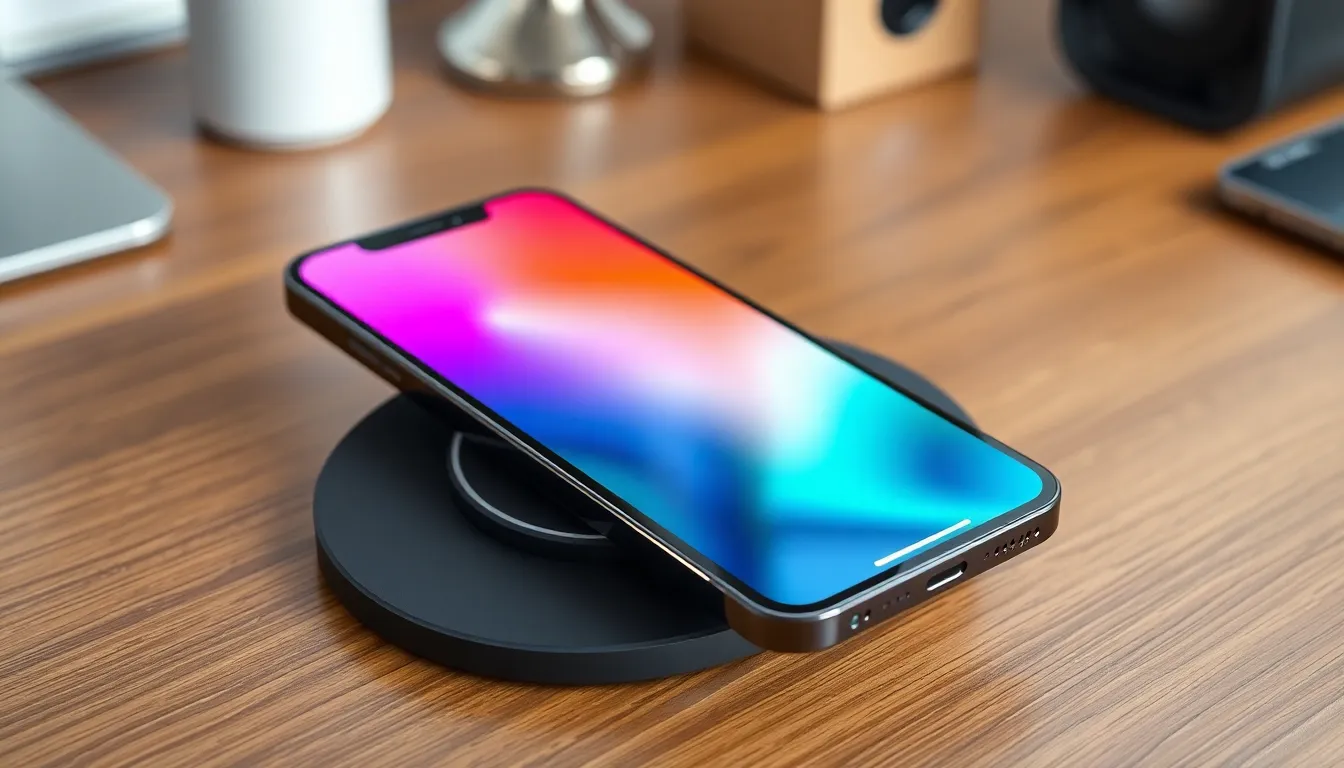
Wireless charging has become common across various iPhone models. Understanding which devices support this feature helps users make informed decisions.
Compatible iPhone Models
iPhone models that feature wireless charging include iPhone 8, iPhone 8 Plus, and all subsequent versions, such as iPhone X, iPhone XR, iPhone XS, and iPhone 11 series. If users own an iPhone 12, 13, or 14 series, they’ll enjoy faster wireless charging options. Additionally, the iPhone SE (2nd generation) supports this technology. All these models comply with Qi wireless charging standards, ensuring compatibility with most charging pads available on the market.
Incompatible iPhone Models
Earlier iPhone models lack wireless charging capabilities. These include iPhone 7, iPhone 6s, and iPhone 6. Models preceding the iPhone 8 require a wired charger to recharge effectively. Users with these devices must seek alternative charging solutions as they cannot utilize wireless charging pads. Understanding this limitation helps avoid frustration when attempting to use newer charging technologies.
How to Check Your iPhone’s Compatibility
Determining if an iPhone supports wireless charging involves a few simple steps. Users can verify compatibility through the model number and Apple’s support resources.
Checking Model Number
Finding the model number is straightforward. Users can access it by going to Settings, tapping on General, and selecting About. The model number appears under the Model Name section. Users should note that models like the iPhone 8 and newer support wireless charging. Identifying earlier models, such as the iPhone 7 and earlier, indicates they do not offer this feature. Each compatible model aligns with Qi standards, ensuring efficient charging.
Using Apple’s Support Resources
Apple provides comprehensive support tools to check compatibility. The official Apple website lists compatible iPhones and their specifications. Users can explore the “iPhone Features” page for detailed information about wireless charging support. Additionally, Apple’s customer support assists in addressing specific inquiries. Seeking help through online chat or phone support offers users clarity on compatibility issues. These resources help users confirm if their device can utilize wireless charging technology effectively.
Benefits of Wireless Charging for iPhone Users
Wireless charging provides numerous advantages for iPhone users, enhancing convenience while minimizing wear on devices.
Convenience and Ease of Use
Convenience stands out as a primary benefit of wireless charging. Users can simply place their iPhone on a charging pad without fumbling with cables. Eliminating the need to plug and unplug a device streamlines the charging process, especially in busy environments like cafes or offices. Charging pads often accommodate multiple devices, allowing users to charge their iPhones alongside other tech accessories. Additionally, many charging pads offer a non-slip surface, ensuring that the phone remains securely in place while charging.
Reducing Wear and Tear on Charging Ports
Reducing wear and tear on charging ports becomes another significant advantage. Frequent plugging and unplugging can damage charging ports over time, resulting in connectivity issues. Wireless charging eliminates the need for physical connectors, preserving the integrity of the charging port. Users benefit from longer device longevity as a result. With wireless charging, the risk of debris accumulating in the port decreases, contributing to overall device maintenance. Thus, this technology not only offers convenience but also safeguards the device from potential wear.
Understanding whether an iPhone is compatible with wireless charging is essential for maximizing convenience and efficiency. Users with models from the iPhone 8 onward can enjoy the benefits of this technology without hassle. By following simple steps to check compatibility and utilizing Apple’s resources, users can easily determine if their device supports wireless charging.
Embracing wireless charging not only simplifies the charging process but also helps maintain the longevity of the device. With features designed to enhance user experience and ease of use, wireless charging stands out as a modern solution for today’s fast-paced lifestyle.


